- Kindred
- Posts
- How to Connect with Anyone
How to Connect with Anyone
In 3 Simple Steps

Eric Jeng
April 21, 2026
As human beings, we are wired to reflect what we receive. Give warmth, get warmth. Give attention, get attention. Give a piece of yourself, and more often than not, the other person will give a piece of themselves back.
Once you understand that, the three steps below stop feeling like tactics. They start feeling like what they really are - acts of care.
Step 1: Assume Rapport
Most of us walk into new interactions with a quiet hesitance. A wait-and-see energy. I'll open up once I know it's safe.
The problem is, the other person is usually thinking the same thing.
So nothing happens. Two people, both waiting for the other to go first. Both hoping.
Assuming rapport means you go first.
It means walking in with the quiet belief that a connection already exists - in your shared humanity, in your common experiences, in the simple fact that you're both just people trying to get through the day. It means assuming pre-existing connection and warmth.
This shows up simply. In your posture. In your eye contact. In how you smile before anything has been said or earned.
It might be as simple as saying, “Good to see you,” instead of a guarded “Hey.”
Or asking a follow-up question with genuine warmth instead of polite obligation.
And because we are reciprocal creatures - the other person feels it. And they reflect it right back.
Now, there's a calibration here worth noting. Assuming rapport doesn't mean greeting a stranger like a long-lost friend. That's not warmth, that's pressure. The idea is to be one step warmer than the situation technically calls for.
If they're a stranger, greet them like a casual acquaintance.
If they're an acquaintance, greet them like a friend.
If they're a friend, greet them like you haven't seen them in years.
One step. That's it.
It's a small thing. But it's also a brave one. You're extending yourself before you know how it'll land. And that little bit of vulnerability? That's exactly what makes it work.
Step 2: Mirror
Okay. You’ve assumed rapport, the interaction is off to a warm start. Now it’s about making the other person feel comfortable and seen.
That's what mirroring does. Emulate them. Be their mirror.
If they speak slowly and thoughtfully, slow down with them.
If they're animated and quick, bring a little more energy.
If they tend to keep physical distance, respect it. If they're warm and close, don't pull away.
We are naturally drawn to people who feel similar to us - people who move at our pace, match our energy, take up space the way we do. Mirroring is the conscious practice of meeting someone where they are, rather than where you happen to be.
It works in conversation too - maybe even more powerfully there.
When someone tells you something, reflect it back. Not just the words, but the feeling underneath.
It might sound like: "So the thing that really got you at work wasn't the outcome itself - it was that nobody even asked for your input."
Or sometimes it's even simpler - just repeating the last few words they said, gently, as a question. "You felt completely blindsided?" Or the gold-standard empathy question: "What was that like?”
It’s like you’re holding a mirror to the other person, so that when they see you, they see a kindred spirit.
Here's the thing about connection - it needs two parts.
If only one person reveals themselves, that's not connection. That's a spotlight.
For a long time, I thought I was pretty good at connecting with people. I asked thoughtful questions. I listened well. I made people feel seen.
But I wasn't actually connecting with them. I was watching them connect with themselves.
Because I never let them in. I stayed comfortable on my side of the bridge and called it being a good listener. What I genuinely believed was selfless - I now realize was a little selfish. I was quietly denying the other person the chance to connect with me. All because I was afraid to, or unpracticed at, revealing myself.
But connection cannot happen unless both people have revealed themselves. Connection is a two-way street.
Questions are a beautiful way to start. When you ask, you guide the conversation, and most people genuinely love talking about themselves - there's nothing wrong with that, it's human. After a while, many will naturally redirect: what about you? Or they'll pause, and you'll feel the opening.
Take it.
Share something that connects back to what they've shared. The key is the bridge - you're not changing the subject, you're extending it.
If they've been telling you about a difficult boss:
"That really resonates. At my first job, my manager had this habit of piling on right before the weekend - you'd be heading out Friday afternoon and suddenly have three new things sitting on you. I started dreading Fridays."
Then tie it back to them. "Did it ever feel personal with your boss, or more like - that's just how they were with everyone?"
You shared something real. And then you handed the conversation back.
That's the rhythm. Receive, reflect, reveal, return.
Not every person will ask about you - some people just aren't built that way, and that's okay. You can also simply step in when the moment feels right. If they're genuinely curious about you, they'll stop and listen, the same way you listened to them. You'll feel it.
The Whole Thing, Simply
Assume rapport. Mirror. Share.
R. M. S.
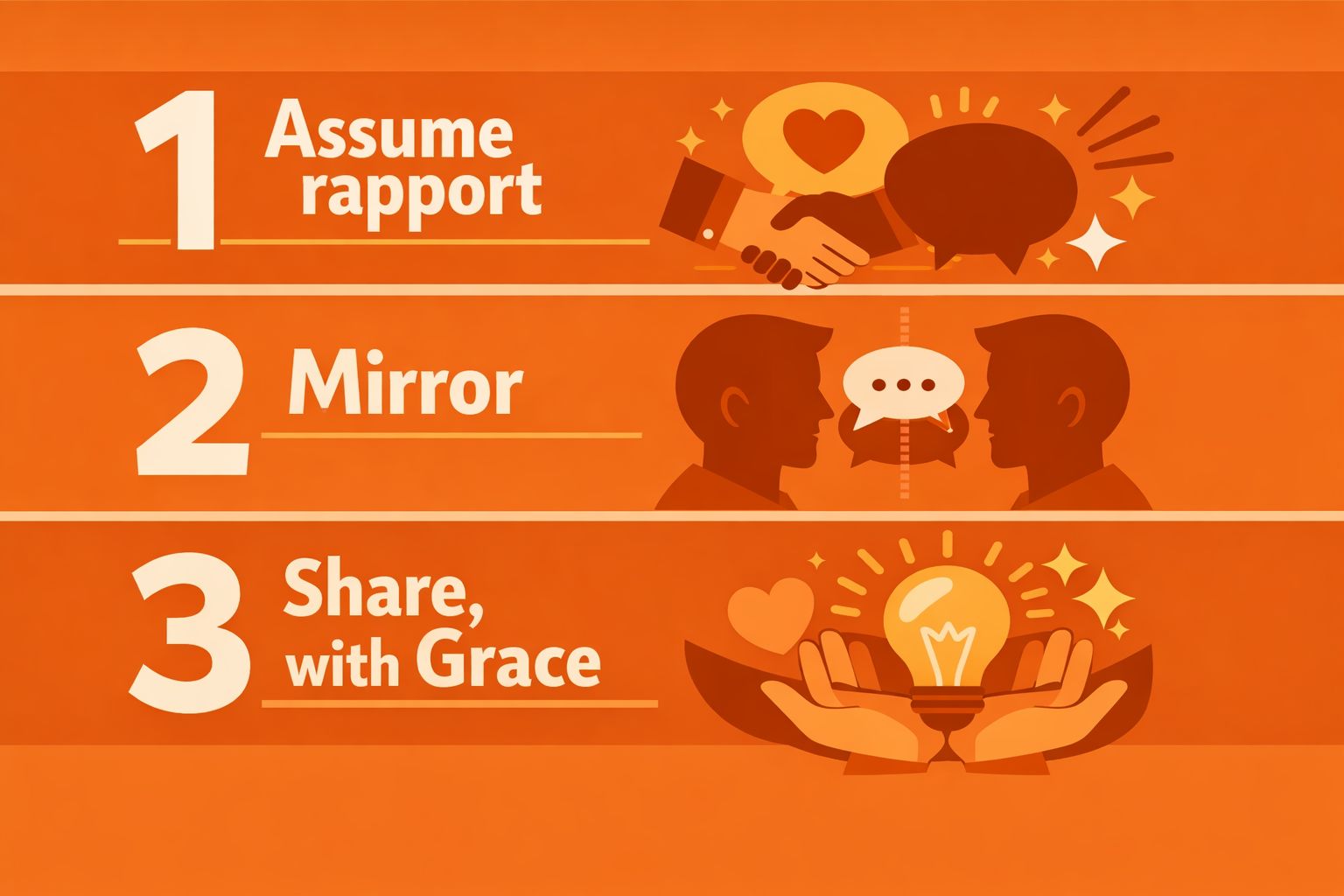
Each step is an act of care. Each one says, in its own way: I see you. I'm here with you. And I'm willing to let you see me too.
That's really all connection is - two people finding the bridge between them, and being brave enough to walk toward each other.
Lastly, don't forget - because people are unpredictable and connection is variable, there's always a little luck involved. That said, the ideas above will make sure you put your best foot forward every time.
With curiosity,
Eric
If this article was helpful consider forwarding it to a friend. If you haven’t subscribed yet, click the button below to subscribe and never miss out on more articles: