- Kindred
- Posts
- How to Deal with Rejection
How to Deal with Rejection
The Wound Beneath the No

Eric Jeng
April 06, 2026
What we fear in rejection is not always the no itself.
Sometimes it is what the no seems to say about us.
A Small Moment in Madrid
Last month I traveled to Spain to do video interviews.
I am always a little uneasy in foreign countries.
Unsure of the social norms. Unsure how people will respond to a stranger with a camera asking for their time.
One afternoon I found myself in a small park near the center of Madrid. I walked past two young women sitting at a table, speaking English with British accents.
I thought - this is a good moment.
"Hi," I said, slight wave. "Do you guys speak English?"
They looked at each other.
Then back at me.
Silence.
Then one of them said, snarkily - "Si."
They both laughed like there was an inside joke I was not part of.
I thought maybe they felt I was trying to hit on them, so I quickly gave them my spiel about being a filmmaker from New York, looking for people to interview. More silence. More looks exchanged. As if they expected me to figure out from their silence that the answer was no.
I excused myself and left.
I felt embarrassed and a little hurt.
The rest of that afternoon I could not shake that awkward interaction. I kept approaching people - everyone else was warm and open - but I couldn’t stay present.
Eventually I just went home.
The next day I was walking through Gràcia, a colorful part of the city that feels more like a small village than a neighborhood. A man was coming toward me wearing a slick leather jacket.
As we passed, I nodded and said something nice about his jacket.
He looked at me, then back ahead and kept walking.
Did not even blink.
And yet - the sting of rejection lasted a second. I was able to keep going like nothing happened.
That night I sat with it. Why had those two women rattled me for hours, when this man, who was honestly colder, barely touched me?
The answer to that question taught me an important lesson about rejection.
The Pain Isn’t in the No — It’s in What We Think It Means
When the women rejected me, I was not just feeling that moment.
I was feeling the girl in middle school who looked at the flowers I gave her on Valentine's Day and walked away. The cool girls in high school I never felt good enough for. Somewhere in those few seconds in the park, my mind had quietly turned these two strangers into every woman who had ever made me feel small.
The old record started playing.
You're not good enough. Women don't like you. You're not cool. You're not enough.
The man in the leather jacket? I have never been romantically rejected by a man. No wound there. So I could see the interaction for exactly what it was - a stranger who did not want to talk.
Nothing more.
This is what is usually happening when rejection hits harder than it should.
We are not just feeling the present moment.
We are feeling every time this happened before - especially the early ones. The ones that landed when we were still figuring out who we were.
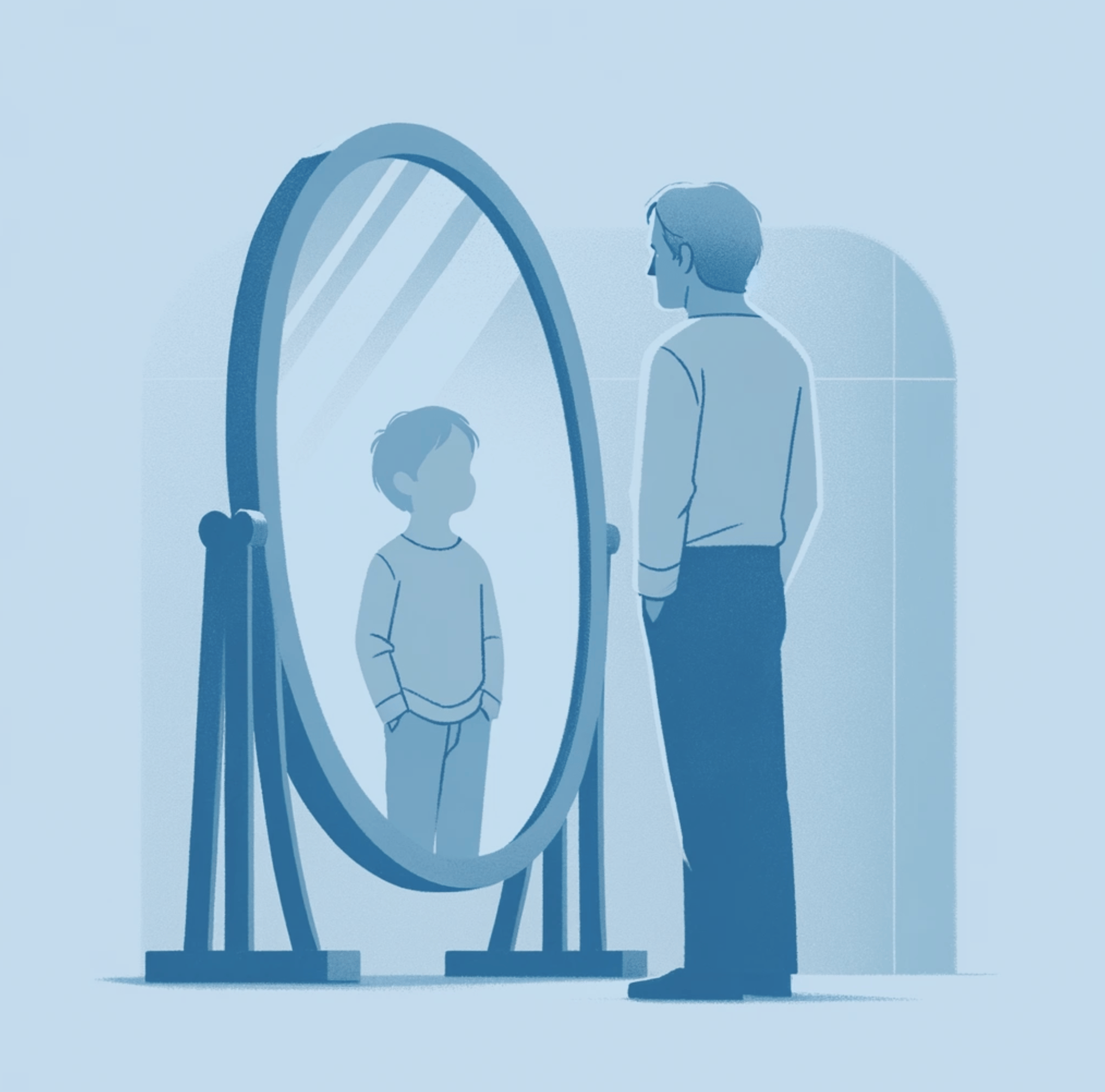
Is current you or past you hurting?
Psychologists sometimes describe this as emotional memory, patterns we formed early on that shape how we interpret moments now.
Basically, those rejections leave a mark. And that mark has a voice.
But here is the thing - sometimes we are not even feeling what actually happened. We are feeling the story we told ourselves about what happened.
I know this because I recently ran into that girl from middle school. The one who rejected my flowers on Valentine's Day. I brought it up playfully, laughing about how much it had stung.
She did not remember it at all.
Not because she was being kind. But because to her, it was just another Valentine's Day at school. She could not keep track of all the flowers kids were handing out that day.
The rejection that had lived in me for years - the one my mind had replayed and built a whole story around - had barely registered as a moment for her.
I see this pattern often, not just in myself.
A client of mine told me recently they were afraid to pursue someone they liked.
Afraid they were not good enough. Afraid, somehow, that their low standardized test scores made them less worthy of love.
I remember thinking - since when did SAT scores factor into dating?
So we dug into it.
And we found that an old partner had once belittled them for their scores. Questioned whether they were smart enough to be loved. Something that happened ten years ago was still deciding what felt possible today.
That is how rejection works on us.
A small no in the present opens an old wound from the past. And suddenly you are not just dealing with what happened - you are dealing with everything it seems to confirm.
It is not always the event. It is the meaning we attach to it.
What opportunities are you not pursuing today because of a wound from years ago - a wound that has nothing to do with where you are now?
Because if you do not examine the wound, you will keep organizing your life around protecting it.
And in doing so, you may miss the things that actually belong to your life now.
Rejection, Reframed
Here’s the thing: rejection, by itself, can actually be quite useful.
Sometimes it is simply what it is - the wrong fit, the wrong timing, the wrong room. Nothing more.
Other times it is a signal. An honest invitation to grow. Looking back to that awkward interaction, I can think about how I might have approached those two women differently - with more warmth, more playfulness, less of an agenda.
That is a worthwhile question.
What is wrong with me is not.
The trap is letting an external no become an internal identity.
Letting someone else's no become the story you tell about yourself.
Beyond usefulness, rejection is also serendipitous. I’ll explain.
In my work, rejection is constant.
Sometimes I go through five, ten strangers on the street who say no before I find one person who says yes. And I used to let the accumulation of no's wear me down.
But I have done this long enough to know something now.
All the no's are usually just pointing me somewhere.
So many times I have walked around for hours getting declined, only to eventually reach the one person who gave me the conversation I was meant to have. The one that made the whole day worth it. Had any of those other people said yes, I may never have gotten to them.
That is why I have learned - slowly, genuinely - to honor rejection.
Not because it feels good.
Not because it does not sting.
But because rejection reveals things.
Sometimes it reveals a wound that still needs care.
Sometimes it shows me a place I can grow.
And sometimes it simply clears the path - helping me move past what is not for me, and toward what is.
So if you are facing rejection right now, or afraid to put yourself somewhere rejection might happen - here is my encouragement:
Do not just ask, how do I get over this?
Ask, why does this scare me so much?
Ask, is this moment really about now - or is it touching something older?
I get it, rejection is painful and scary.
But perhaps bringing some awareness and curiosity could turn it into something beautiful.
With curiosity,
Eric
PS: I have a few coaching spots open right now. If any of this resonated - if there is an old wound still running the show, or a fear of rejection quietly keeping you small - reach out. Just reply to this email and tell me what is going on. I would love to help.
If this article was helpful consider forwarding it to a friend. If you haven’t subscribed yet, click the button below to subscribe and never miss out on more articles: